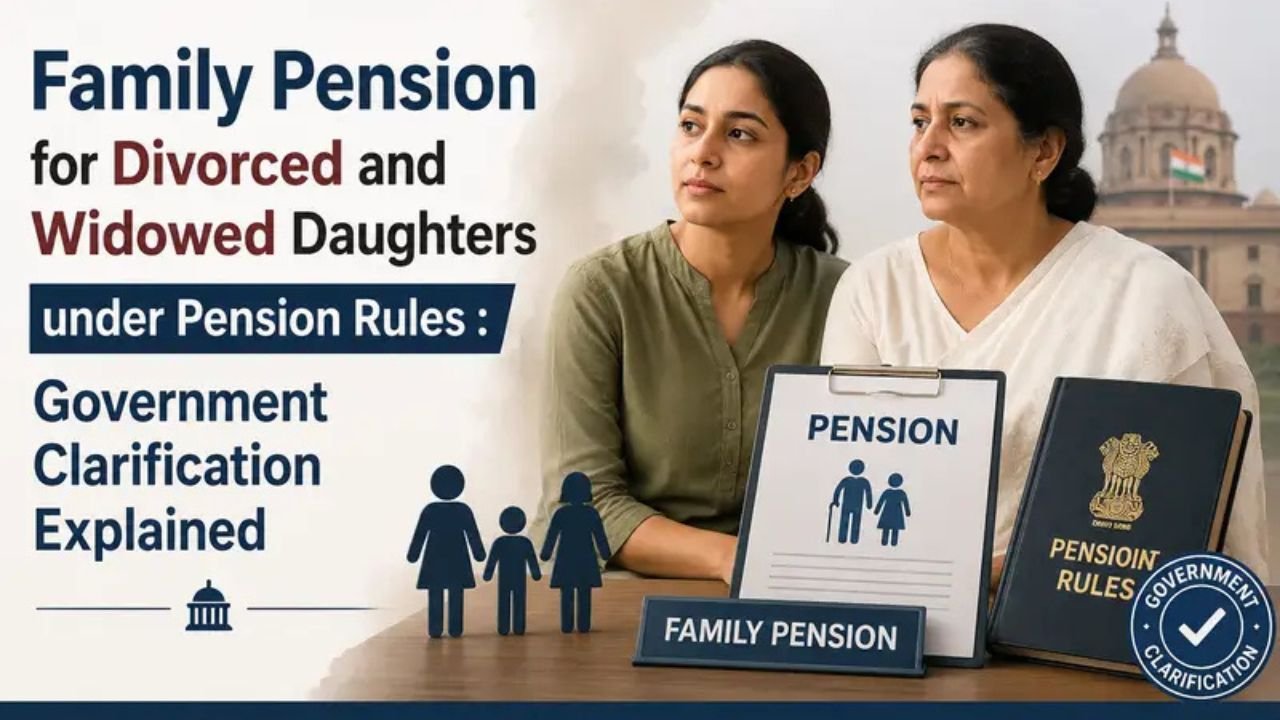
Family Pension 2026 : The Government of India has made it easier to understand who can receive a family pension after a government employee or pensioner passes away. Under the Central Civil Services (CCS) Pension Rules, 2021, divorced and widowed daughters may also receive family pension benefits. These rules were created to provide financial support to daughters who depend on their parents and have no stable source of income. The government has also issued clear explanations to remove confusion about these benefits.
Who Can Receive Family Pension?
A divorced or widowed daughter can receive family pension only when there is no higher-priority family member eligible for the benefit. For example, if there is no surviving spouse, eligible son, daughter, or disabled child, then the pension can be given to a divorced or widowed daughter. The rules follow a fixed order of priority. This system ensures that family pension reaches the person who needs financial support the most.
Main Conditions for Eligibility
To receive family pension, a daughter must meet certain conditions. She should be above 25 years of age and should not have enough income to support herself. Financial dependency on the parents is an important requirement. The government designed this benefit to help daughters who face financial difficulties after divorce or the death of their husband. The pension continues only as long as the daughter remains eligible under the rules.
Important Clarifications by the Government
One major clarification is that a daughter can become divorced even after the retirement or death of her parents and still become eligible for family pension when her turn comes. For widowed daughters, the husband’s death should have occurred during the lifetime of the government employee, pensioner, or spouse. For divorced daughters, either the divorce should have taken place or divorce proceedings should have started in a court during the lifetime of the parent or spouse. These clarifications have helped many families understand their rights better.
When Does the Pension Stop?
Family pension is not always permanent. It can stop under certain situations. If the daughter gets married or remarried, the pension will end. It will also stop if she becomes financially independent and starts earning enough for her livelihood. Naturally, the pension also ends upon her death. Therefore, continued eligibility depends on both financial need and marital status.
Why These Rules Matter
These pension rules provide important financial security to daughters who may be facing difficult circumstances. The government’s aim is to protect vulnerable family members and ensure fair treatment. The rules also help pension authorities make decisions more consistently. By recognizing the needs of divorced and widowed daughters, the pension system supports social welfare and provides dignity and financial stability to those who need it most.
Family Pension Eligibility Facts at a Glance
| Feature | Details |
|---|---|
| Pension Rule | CCS (Pension) Rules, 2021 |
| Eligible Daughters | Divorced, Widowed, or Unmarried Daughters |
| Minimum Age | Above 25 years |
| Dependency Requirement | Must be financially dependent |
| Higher Priority Beneficiaries | Must not exist |
| Disabled Child Condition | No eligible disabled child should be receiving pension |
| Divorce Timing | Divorce or court proceedings during parent’s/spouse’s lifetime |
| Widowhood Condition | Husband’s death during parent’s/spouse’s lifetime |
| Pension Duration | For life, subject to eligibility |
| Pension Stops If | Marriage, remarriage, self-sufficiency, or death |
| Government Clarification | Office Memorandum dated 26 October 2022 |
| Purpose | Financial protection and social security |
Collector-Style Quick Notes
- Family pension is available only after higher-priority beneficiaries are not eligible.
- Financial dependency is one of the most important conditions.
- Divorced daughters may qualify even if divorce happens after parents’ retirement.
- Widowed daughters can also receive support under the rules.
- Marriage or remarriage usually ends eligibility.
- The rules aim to provide long-term social and financial protection.
Frequently Asked Questions (FAQs)
1. Can a divorced daughter receive family pension?
Yes. A divorced daughter can receive family pension if she meets all eligibility conditions and there are no higher-priority beneficiaries.
2. Is there an age limit for receiving family pension?
The benefit applies to unmarried, widowed, or divorced daughters who are above 25 years of age.
3. Does the daughter need to be financially dependent?
Yes. Financial dependency is a key requirement under the pension rules.
4. Can pension continue after the daughter starts earning?
No. If she becomes financially self-sufficient, the family pension generally stops.
5. Will the pension continue after remarriage?
No. Family pension normally ends if the daughter gets married or remarried.
6. What happens if there is a surviving spouse of the pensioner?
The surviving spouse has higher priority. The daughter can receive pension only after higher-priority beneficiaries are no longer eligible.
7. Can a daughter become eligible after her parents have passed away?
Yes. Government clarifications allow eligibility in certain situations even if divorce occurs after the parents’ death, subject to prescribed conditions.
8. Why were these rules introduced?
The rules were introduced to provide financial support, social security, and dignity to dependent daughters facing difficult circumstances.